How to Calculate Measurement Uncertainty for ISO 17025 (The GUM Method)
Calculating Measurement Uncertainty is the number one reason laboratories receive non-conformances during audits. If you are struggling with Type A vs Type B evaluation, this guide simplifies the process.
Step 1: Understand the Two Types
The Guide to the Expression of Uncertainty in Measurement (GUM) classifies uncertainty into two categories:
- Type A: Evaluated by statistical analysis of series of observations (Repeatability).
- Type B: Evaluated by other means (Calibration Certificates, Resolutions, Specs).
Step 2: Calculate Type A (Repeatability)
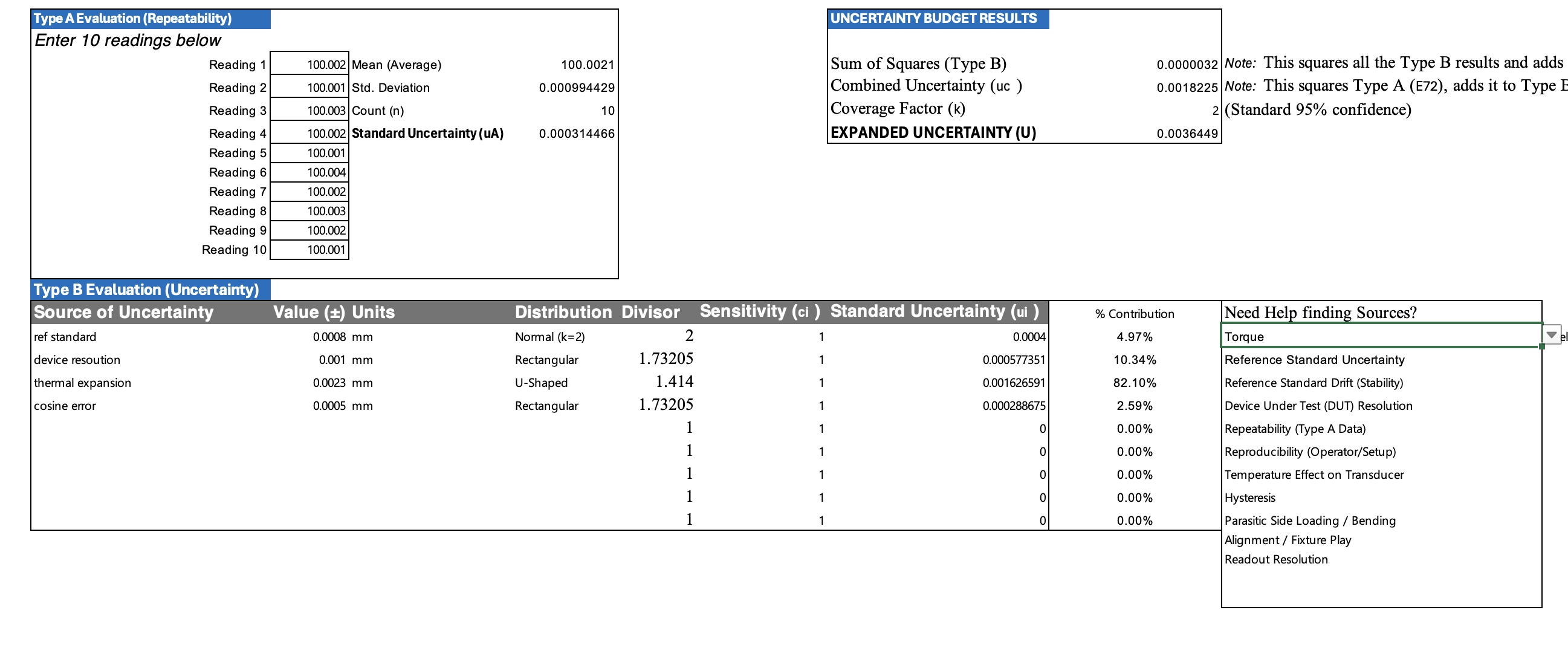
To calculate Type A, you must take repeated measurements (usually 10) of a reference standard. Calculate the Standard Deviation and divide it by the square root of the number of samples.
Formula: uA = StDev / √n
Step 3: Identify Type B Sources
This is where most labs fail. You must identify systematic errors. Common sources include:
- Reference Standard Uncertainty (from your calibration cert).
- Resolution of the Device Under Test.
- Temperature Variation (Thermal Expansion).
- Drift over time.
Step 4: Combine and Expand
Once you have all standard uncertainties, combine them using the Root Sum Square (RSS) method. Finally, multiply by a coverage factor (usually k=2) to get your Expanded Uncertainty (approx 95% confidence).
Need to automate this math? Check out our Excel tool on the right.